Showing posts with label Hay. Show all posts

Wednesday, September 15, 2010

Churchill in War and Peace


Another of my Hay purchases was a biography of Winston Churchill that I picked up for a couple of quid. It was written by the Labour MP Emrys Hughes in 1950, and is basically a long election pamphlet explaining why Churchill would be a disastrous choice in the 1950 or 1951 election.

It is a fascinating document and shows how the contents of campaigning has changed little in the intervening 60 years. Churchill is portrayed as a disastrous leader who is only ever right by luck and would lead Britain into war as soon as he could.

To be fair to Hughes he was consistent in his opposition to war: he notes he was one of the Labour delegates at the 1940 special conference to vote against endorsing the coalition and spoke out then ("The resolution says the new Prime Minister commands the confidence of the nation. Even in war time this is too much for me." p172).

However he plays every trick in the leaflet writers lexicon: quoting out of context, attacking a change in position over several years as a bad thing (is it perhaps possible that Hitler and Germany had become a bigger threat than the Soviet Union?), attacking Churchill for not prolonging the war to deal with Soviet abuses, and attacking Churchill for his attacks on the Soviet Union. Churchill's position on the abdication is attacked by Hughes, but it isn't clear whether Hughes agrees with Baldwin or with Churchill: this reservation of position is used in several places and is quite sneaky. The section on the start of the war is good too.

One favourite bit is on p174: Churchill's famous "I have nothing to offer but blood, toils, tears and sweat" speach is observed to be, brace yourself, not wholly original but to have classical and later historical predecessors ("Livy, Cicero, Ennius, Pizarro and Garribaldi").

The shelving of the Beveridge report is mentioned, what isn't is that it was part of the Conservative 1945 manifesto as well as both the Liberal and Labour parties.

There is plenty og grounds to attack Churchill of course: his move from Conservative to Liberal and back; his excessive praise of Mussolini; the Dardanelles campaign and the British intervention in the Russian civil war to pick four.

However this is a terrific hatchet job: Churchill is not the Labour candidate so he must be shown to have no merit at all. Success is in spite of him, failure because of. This is still eveident in the election dialogue of all parties.

There is relevance today: this is the style of political campaigning that AV would limit. There is no positive reason to vote for Labour given, just a reason not to vote Conservative. When everyone does this why are we surprised that turn out falls? I might annoy people with a return to this theme later.

Sunday, August 15, 2010

What I read on my holiday... Riddles in Mathematics


Riddles in Mathematics: A Book of Paradoxes is a popular mathematics book written in 1944, revised in 1961. I purchased a 1975 reprint at Hay, and finally got round to reading it on holiday.

It is good fun, if a little dry and could be accused of being a little like a text book: there is a discussion, and couple of examples and then some paradoxes for you to resolve (or exercises). To get the most out of the book you do need to engage with the maths: you'll need pencil and paper and a willingness to get your algebra out.

The dated bits are in geometry: sadly Euclidean proof has dropped off the school curriculum (in favour of more statistics). I think there is nothing in the section that isn't in GCSE Maths, but probably in a different style. Also the four colour theorem has now been proved, albeit in an aesthetically unsatisfactory way.

The chapter on the infinite is great, and the chapter on probability has provoked me to get Grimmett and Walsh out to revise my probability.

A couple of my favourite paradoxes. Firstly one from p169 that I've put into steps and changed slightly.

1. If something has probability 0 it is impossible.
2. It is known there are an infinite number of primes
3. We only know a finite number of them (the highest known prime has just under thirteen million digits). Call it P.
4. The probability of picking a known prime is P dividied by the number of primes.
5. Any finite number divided by infinity is 0.
6. Therefore the probability that an arbitrary prime is known is 0.
7. Therefore it is impossible that an arbitrary prime is known.
8. Therefore there are no known primes

A round of applause to anyone who can pick the (many) holes in that. It is the same basic construction as Douglas Adam's proof that the population of the universe is 0.

Also worth a look are the geometric probabilities (p172-3).

Some good ol' algebraic sleight of hand is included, like this from p86:

1. Let b and c be two different positive numbers.
2. Let a = b + c. Note a must be greater than b.
3. Multiply by (a-b) to get a^2 - ab = ab - b^2 + ac - bc
4. Take off ac: a^2 - ab - ac = ab - b^2 - bc
5. Factorise: a(a-b-c) = b (a-b-c)
6. Divide by a-b-c to get a = b, but this contradicts a being bigger than c. So any two different numbers are the same (chose to be c=a-b)
7. In fact as b+c=a we have b+c=b, which means c=0.
8. But c was an arbitrary positive numbers, so all arbitrary positive numbers are 0!

Again a round of applause to those who can hit that one into touch. A bit easier I think.

I think you'd need to be a bit odd to enjoy the book: you'd need solid secondary school mathematics, and a willingness to play with the maths. Like me.

Saturday, July 17, 2010

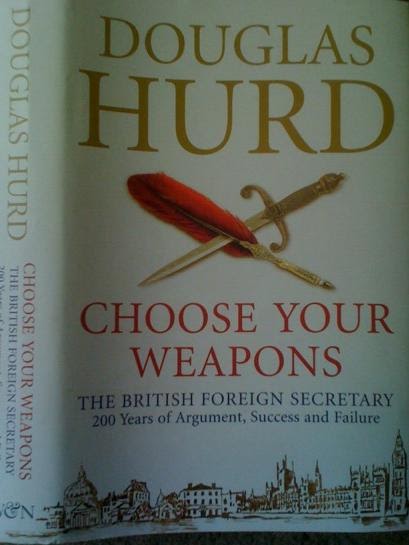
Hurd and Young: Choose Your Weapons


At the Hay Festival this year one event that I went to was Douglas Hurd and Edward Young talking about their book Choose Your Weapons: The British Foreign Secretary 200 Years of Argument, Success and Failure. It was a brilliant discussion, with Hurd showing a level of knowledge and understanding of foreign affairs that was impressive, and also making his arguments with great clarity and thought.

One nice moment was when the panel were asked if they felt that the Iraq war was still damaging the United Kingdom in Eurovision. Edward Young replied that he felt we lost this year because the song wasn't very good to general murmurs of approval.

More poignant was Hurd's response when the New Labour "ethical foreign policy" (or "foreign policy with an ethical dimension") was raised in the discussion. This is also included in the book. The authors make the point that "it is sometimes the duty of a Foreign Secretary to deal courteously with villains" (p312) and observe that meeting and talking is not "an act of surrender but of good sense" (p369). It should be noted that the UK engaged with people that could be described as villains throughout the Labour government. I do remember feeling that change was needed in 1997, but looking back I can't see a great improvement that Cook claimed he could make. Hurd was quite clear at Hay that he felt the Conservative foreign policy had an ethical dimension, but that this is not a simple matter.

I found the book very interesting. Hurd and Young's style is very readable. It could be said to be dry, but there is enough human interest to make up for this.

I would strongly suggest that you don't drop this book on the foot of your wife (or anyone else you care about). I think I've been forgiven, but the book hasn't.

The centrepiece of the book is a comparison between (Conservative) constructive diplomacy and (Liberal) interventionism and adventure. Or to put it another way between Castlereagh's attempt to create a system of treaties after the Napoleonic war and Canning's wish to intervene. Hurd looks at appeasement as sometimes positive.

The initial discussion at Hay set up Hurd as the defender of quiet diplomacy, and Young as the advocate of loud interventionism. In fact reading the book, although it is clear that Hurd has a preference for joint working and avoiding conflict, and a suspicion of intervention and threat of intervention, it is clear that both authors see the need for both strands of foreign policy. The epilogue which looks at recent developments and events makes this clear.

On a small scale I learnt the origins of the word Jingo (p145), and came across the original meaning of filibuster (p195; odd this I hadn't ever heard it in the freebooter sense until about a week ago, and then I heard it several times). At a more significant level I found the discussion of the role of the British, and in particular Canning as then foreign secretary, in the origins of the Monroe Doctrine very interesting. The fact that the US could only issue this due to the power of the British is neatly compared to later situations where the British needed US support.

The chapters usually set up a contrast between two people, usually rivals for the position of foreign secretary. This is usually seen as a variation on the two strands outlined above, sometimes more convincingly than others. The problem with this is that, as the authors make clear, it often isn't that simple. Lord Aberdeen seems to be destroyed by the failure of his quiet policy leading to the Crimean war, whilst louder interventionists might have their bluffs called.

Another theme that is looked at quietly, and perhaps could have been made louder, is the role of the cabinet and the Prime Minister. Derby used the cabinet to block Disraeli over intervention in disputes between Russia and Turkey. Eden resigned in 1938 when he couldn't persuade the cabinet to block the PM's (Chamberlain) personal diplomacy with Italy. The unspoken message is that the Cabinet should be powerful enough to check the PM, and that the PM should give the Foreign Secretary space to run foreign policy is clear. The latter belief would appear to come from, or be strengthened by, Hurd's time under Thatcher, the latter from experiences under Blair. We can but hope that coalition might have the effect of reinvigorating cabinet.

This book has made me consider what should be included in foreign policy, and there are several points raised by it that I shall return to in other posts. A good read. Can anyone suggest any other books about British foreign policy to compare and contrast with?

Saturday, July 10, 2010

Clifford Simak binge: Catface, So Bright the Vision etc

My English teacher at school made me read Clifford Simak's novel Way Station. It made a big impact on me, and I really enjoyed it. I've had a soft spot ever since for that book, but somehow never managed to read anything else by him. On a previous visit to Hay I purchased a few books of his to see if they were as good: City and Cemetry World. I'll confess that neither is quite as good as Way Station, but they were good enough for me to try some more.

So on my last trip to Hay I aquired Catface, a novel, and So Bright the Vision, a collection of four long short stories. They are described as novellas on the blurb, but that is a little grandiose. After being thoroughly depressed by the Short History of the Liberal Party, I've spent this week on a binge reading of Simak.

So Bright The Vision is a collection of stories about human contact with alien intelligence/life. Oddly most of them seem to want not a lot more than to tidy up for us, although the twists are fun. The story telling is compelling. Alongside cleaning there is a theme about the links between untruth and story telling and business. Good fun.

Catface is in many ways quite dated, which is ironic for a book about time travel. It suffers at the start from some unconvincing dialogue, but nothing bad enough to make me give up. If you are more sensitive in your literary tastes I'd avoid the first chapter. The book sets up nice problems to consider, and raises interesting questions about the power of state and individual, if only to pretty well ignore them.

Like Way Station the action takes place in rustic America, and celebrates the romantic view of a hardy, independent small community America. There is an element of idealism in the view, but then this is SciFi, not social commentary. I found the ending of Catface rather disappointing.

I then re-read Way Station. It remains one of my favourite books, although I can't quite say why. I love the premise: that a federation of aliens have set up a temporary transit point for their teleportation network on Earth. The lead character is set up so that he bridges alien and human in a believable way (by making him come from the nineteenth century we already have a distance from him used to some effect). Definitely a book that I'd recommend to anyone.

(I have absolutely no idea why the picture ended up turned round. I am blaming blogger for this one. I'm sorry but I gave up when the fifth different attempt to fix it didn't work.)

Friday, July 9, 2010

Animation at Hay - probably last post

As well as the five that I've posted about so far (Yellow Sticky Notes, The Pearce Sisters, Pigeon Impossible, El Empleo and John and Karen) there were five others at the event which I haven't managed to find online.

Fog (if I recall correctly) was an odd story about a mountain village being revived by capturing sheep that fly in the sky. The exploitation of the sheep brings affluence to the village, but then the sheep depart leaving the village depressed again.

I can't recall the title of the film about a daughter who waited for her father to return from a rowing trip. A very sad but beautiful animation.

Another animation which I don't recall the title of appeared to be a music video. A matchstick man travelled from a house, and ends up on a boat at sea. If anyone can find this animation from the description I'd like to know as I'd like to see it again. That actually goes for all four of these.

Finally was Operator. Our here calls directory enquiries to get God's number and is put through. A lovely little conceit. Very nice little short that raises interesting questions and makes you smile.

Tuesday, July 6, 2010

Hay festival animations 5: John and Karen

This is a beautiful and sweet little animation.


However, much as I enjoyed it and especially the little details (the biscuit bending, the reflections, Karen walking round at the crucial moment), I was left wondering if there was anything in it once you got over the cuteness. Nicely observed however, and both John and Karen feel suprisingly real.

Other 4mations animations are also on Youtube.

Monday, July 5, 2010

A Short History of the Liberal Party (1900-1988)

Another of my Hay purchases was Chris Cook's A Short History of the Liberal Party 1900-1988.

This was the third edition of the book, the first being 1900-76, the second 1900-1983. Since 1988 there have been editions for 1900-2001 and oddly enough a new edition is due out later this year.

It is a well written book for the most part. If I was to be very critical I'd comment on three things:
  1. Often Cook mentions some important controversy without explaining the detail. Whilst this is fine for the Thorpe scandal (say), it is a bit more of an issue when talking about (say) the Taff Vale decision.
  2. The book does gloss a little over the scandals of Liberalism: we don't get much on the Lloyd-George honours scandal, and the Thorpe conspiracy trial isn't mentioned at all.
  3. The later sections aren't as detailed as the early sections, becoming catalogues of by-elections.

The third one is probably inevitable. The sources for the details on the spats and controversies of the earlier chapters is presumably private papers that only become available over time. Except for the merger talks, where the fighting was so public, the details of these since the 1970s weren't available in 1988.

I'm quite inclined to buy the new edition when it comes out, partly to see if the 1970s onwards bits have improved, however I'd imagine the bits about the Kennedy and Campbell era will be short of the important details about knife wielders...

I could summarise this book (or, to be fair, the subject matter) with three sentences. For each era pick one...

  • The performance of the Liberals at the general election of XXXX failed to live up to the promise of the by-elections or polls; or
  • Then the party split into two or more parts; or
  • Both of the above

The second one particularly happened when we had coalitions with the Tories. I'm just saying.

Overall it was an enjoyable quick guide, but just a starting point. Definitely worth the £2.50 I paid at Hay.

Friday, July 2, 2010

Animation at Hay 4: Yellow Sticky Notes

Latest animation is Yellow Sticky Notes. Which seems to be a documentary drawn on ... yellow sticky notes. Or PostIt(TM) notes.


The creator has posted a little film about it as well...


This was the first film of the evening, and the one I was most ambivalent about. It was interesting but I'm not sure that there is much beyond the initial idea that he was being limited by his todo lists. I am open to argument though.

Sunday, June 27, 2010

More on Hay animation: Pearce Sisters from Aardman

Not your typical Aardman animation, and in fact quite... dark.

Have a look at the Pearce Sisters, which was one of the shorts at the Hay festival. Aardman have disabled embedding, so I'll wait here while you go and have a look.

Hum-ti-him...

Done?

I love the style. I also like the fact that the central characters show moments of tenderness. The dark humour is also very successful.

Sunday, June 20, 2010

Animation at Hay 2: Pigeon Impossible

I have no comments beyond watch it and if you don't laugh then I am sad.


The creator has put some podcasts up on YouTube too.

Sunday, June 6, 2010

Breaking the Mould?

I have just got back from the Hay Festival, which was an outing of stereotypical Guardian readers to a field in Wales. Good fun but rather depressing in some ways. Sadly I will be back at some point.

I will write about some of the sessions I attended at some point, especially when I've finished reading the books that go with them.

However I did sneak into the second hand bookshops and pick up a few books to add to my backlog of unread books.

One that jumped out at me cost the princely sum of £1.50 and is pictured right. It was written in 1981 and outlines from a broadly sympathetic (I think) position the reasons for the creation of the SDP and what might happen. Ian Bradley went on to different things than you might expect (and yes it is the same person!)

Overall the book reads easily and, at only 161pp, quickly. Ian Bradley is a lively writer. I think his sections on polls had all the health warnings, but the conclusions don't seem to include them. However his final conclusions are interesting:

If the SDP does well at the next election [1983], it will almost certainly help the party which it has broken away from [...]

To be fair to Ian Bradley he couldn't have foreseen the Falklands.

He seems more prescient in the next sentence:
The effect of it's arrival may well be to help the Liberals [...] It is not difficult to imagine after the next election a victorious alliance contingence of MPs which consists of only a handful of Social Democrats, perhaps just 3 or 4 of the exisiting MPs, and a substantial number -- perhaps fifty or more -- of Liberals.

The Liberals did remain the senior grouping in 1983 (17 against 6) and 1987 (17 against 5). But never matched poll levels. Predicting a level of 50 for the Liberal (Democrat) parliamentary party seems reasonable now, but would have been unheard of in the 1980s.

In chapter 2 he gives an overview of new parties. He says that they need 20-30 years to enter government, or vanish in about 5-10 years. The SDP may be unique in doing both: it took 16 years for New Labour to emerge as an arguably Social Democratic government (albeit a bureaucratic centralising one), or 29 years for the LibDems to enter the coalition, but the SDP as a real force vanished in the merger after only 6 years.

Well worth a read if you can find a copy. Which looks easy enough. I may track down a copy of his Strange Rebirth of Liberal England when I've read more of the backlog.