Showing posts with label books. Show all posts

Tuesday, August 17, 2010

MP's diary entries and expenses

I am currently reading the third of the Alan Clark Diaries (Called The Last Diaries) and found an interesting entry early on. It is on p8 of the 2003 paperback edition. It is revealing of Alan Clark's attitudes.

MoD, Thursday, 28 February [1991]
There is now talk of a General Election in June. Just time to claim, massively, some allowances out of 91-92!

[I have removed the rest of the entry, but it doesn't change the meaning.]

I doubt anyone would be surprised by that! Clark's diaries are amazing reading and easily obtained second hand.

Another interesting quote is in Chris Mullin's diary. I think this one shows how easy it is for people to end up becoming part of an institution.

Wednesday, 1 May [2002]
Andrew Mackinlay dropped a little bombshell at this afternoon's meeting of the parliamentary committee. Apparently, under the Freedom of Information Act, by January 2005 MP's expenses will be subject to public scrutiny, retrospectively. Goodness knows what mischief that will cause. 'We are in a jam,' said Robin Cook. 'Few members have yet tumbled to the juggernaut heading their way.' He said he had been advised that we could probably get away with publishing headline figures and it would be desirable to start publishing a year before the deadline so that any fuss would have died down come the general election. It was agreed not to minute the discussion.


[My emphasis and I have removed a second unrelated paragraph from the entry. p284-5 of the hardback first edition. The Parliamntary Committee mentioned is a Labour Party committee to allow backbenchers and the government to stay in touch (see the preface and p226).]

I have a lot of respect for Mullin but this isn't good. I will be careful to note that he doesn't record his view on this, merely reports the committee results, but it is fair to note that he didn't kick off a stink about the decision. It is clear he knew that the claims had issues ("mischief" would result, a "juggernaut", the expectation of "fuss") and agreed to conceal both this (headline only) and the discussion (minutes).

I think what this shows is how easy it is to become loyal to institutions and organisations when you belong to them however honourable and independent you may be.

I am surprised this passage hasn't been picked up on more.

Sunday, August 15, 2010

What I read on my holiday... Riddles in Mathematics


Riddles in Mathematics: A Book of Paradoxes is a popular mathematics book written in 1944, revised in 1961. I purchased a 1975 reprint at Hay, and finally got round to reading it on holiday.

It is good fun, if a little dry and could be accused of being a little like a text book: there is a discussion, and couple of examples and then some paradoxes for you to resolve (or exercises). To get the most out of the book you do need to engage with the maths: you'll need pencil and paper and a willingness to get your algebra out.

The dated bits are in geometry: sadly Euclidean proof has dropped off the school curriculum (in favour of more statistics). I think there is nothing in the section that isn't in GCSE Maths, but probably in a different style. Also the four colour theorem has now been proved, albeit in an aesthetically unsatisfactory way.

The chapter on the infinite is great, and the chapter on probability has provoked me to get Grimmett and Walsh out to revise my probability.

A couple of my favourite paradoxes. Firstly one from p169 that I've put into steps and changed slightly.

1. If something has probability 0 it is impossible.
2. It is known there are an infinite number of primes
3. We only know a finite number of them (the highest known prime has just under thirteen million digits). Call it P.
4. The probability of picking a known prime is P dividied by the number of primes.
5. Any finite number divided by infinity is 0.
6. Therefore the probability that an arbitrary prime is known is 0.
7. Therefore it is impossible that an arbitrary prime is known.
8. Therefore there are no known primes

A round of applause to anyone who can pick the (many) holes in that. It is the same basic construction as Douglas Adam's proof that the population of the universe is 0.

Also worth a look are the geometric probabilities (p172-3).

Some good ol' algebraic sleight of hand is included, like this from p86:

1. Let b and c be two different positive numbers.
2. Let a = b + c. Note a must be greater than b.
3. Multiply by (a-b) to get a^2 - ab = ab - b^2 + ac - bc
4. Take off ac: a^2 - ab - ac = ab - b^2 - bc
5. Factorise: a(a-b-c) = b (a-b-c)
6. Divide by a-b-c to get a = b, but this contradicts a being bigger than c. So any two different numbers are the same (chose to be c=a-b)
7. In fact as b+c=a we have b+c=b, which means c=0.
8. But c was an arbitrary positive numbers, so all arbitrary positive numbers are 0!

Again a round of applause to those who can hit that one into touch. A bit easier I think.

I think you'd need to be a bit odd to enjoy the book: you'd need solid secondary school mathematics, and a willingness to play with the maths. Like me.

Saturday, July 17, 2010

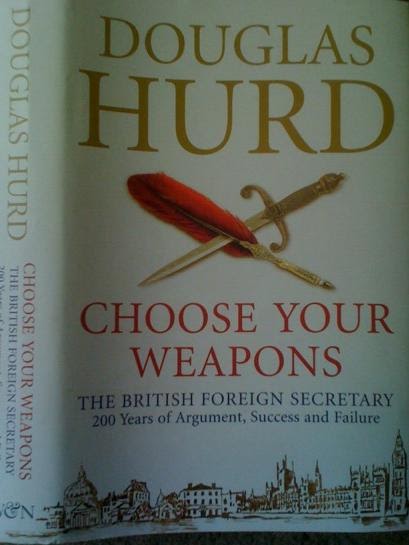
Hurd and Young: Choose Your Weapons


At the Hay Festival this year one event that I went to was Douglas Hurd and Edward Young talking about their book Choose Your Weapons: The British Foreign Secretary 200 Years of Argument, Success and Failure. It was a brilliant discussion, with Hurd showing a level of knowledge and understanding of foreign affairs that was impressive, and also making his arguments with great clarity and thought.

One nice moment was when the panel were asked if they felt that the Iraq war was still damaging the United Kingdom in Eurovision. Edward Young replied that he felt we lost this year because the song wasn't very good to general murmurs of approval.

More poignant was Hurd's response when the New Labour "ethical foreign policy" (or "foreign policy with an ethical dimension") was raised in the discussion. This is also included in the book. The authors make the point that "it is sometimes the duty of a Foreign Secretary to deal courteously with villains" (p312) and observe that meeting and talking is not "an act of surrender but of good sense" (p369). It should be noted that the UK engaged with people that could be described as villains throughout the Labour government. I do remember feeling that change was needed in 1997, but looking back I can't see a great improvement that Cook claimed he could make. Hurd was quite clear at Hay that he felt the Conservative foreign policy had an ethical dimension, but that this is not a simple matter.

I found the book very interesting. Hurd and Young's style is very readable. It could be said to be dry, but there is enough human interest to make up for this.

I would strongly suggest that you don't drop this book on the foot of your wife (or anyone else you care about). I think I've been forgiven, but the book hasn't.

The centrepiece of the book is a comparison between (Conservative) constructive diplomacy and (Liberal) interventionism and adventure. Or to put it another way between Castlereagh's attempt to create a system of treaties after the Napoleonic war and Canning's wish to intervene. Hurd looks at appeasement as sometimes positive.

The initial discussion at Hay set up Hurd as the defender of quiet diplomacy, and Young as the advocate of loud interventionism. In fact reading the book, although it is clear that Hurd has a preference for joint working and avoiding conflict, and a suspicion of intervention and threat of intervention, it is clear that both authors see the need for both strands of foreign policy. The epilogue which looks at recent developments and events makes this clear.

On a small scale I learnt the origins of the word Jingo (p145), and came across the original meaning of filibuster (p195; odd this I hadn't ever heard it in the freebooter sense until about a week ago, and then I heard it several times). At a more significant level I found the discussion of the role of the British, and in particular Canning as then foreign secretary, in the origins of the Monroe Doctrine very interesting. The fact that the US could only issue this due to the power of the British is neatly compared to later situations where the British needed US support.

The chapters usually set up a contrast between two people, usually rivals for the position of foreign secretary. This is usually seen as a variation on the two strands outlined above, sometimes more convincingly than others. The problem with this is that, as the authors make clear, it often isn't that simple. Lord Aberdeen seems to be destroyed by the failure of his quiet policy leading to the Crimean war, whilst louder interventionists might have their bluffs called.

Another theme that is looked at quietly, and perhaps could have been made louder, is the role of the cabinet and the Prime Minister. Derby used the cabinet to block Disraeli over intervention in disputes between Russia and Turkey. Eden resigned in 1938 when he couldn't persuade the cabinet to block the PM's (Chamberlain) personal diplomacy with Italy. The unspoken message is that the Cabinet should be powerful enough to check the PM, and that the PM should give the Foreign Secretary space to run foreign policy is clear. The latter belief would appear to come from, or be strengthened by, Hurd's time under Thatcher, the latter from experiences under Blair. We can but hope that coalition might have the effect of reinvigorating cabinet.

This book has made me consider what should be included in foreign policy, and there are several points raised by it that I shall return to in other posts. A good read. Can anyone suggest any other books about British foreign policy to compare and contrast with?

Saturday, July 10, 2010

Clifford Simak binge: Catface, So Bright the Vision etc

My English teacher at school made me read Clifford Simak's novel Way Station. It made a big impact on me, and I really enjoyed it. I've had a soft spot ever since for that book, but somehow never managed to read anything else by him. On a previous visit to Hay I purchased a few books of his to see if they were as good: City and Cemetry World. I'll confess that neither is quite as good as Way Station, but they were good enough for me to try some more.

So on my last trip to Hay I aquired Catface, a novel, and So Bright the Vision, a collection of four long short stories. They are described as novellas on the blurb, but that is a little grandiose. After being thoroughly depressed by the Short History of the Liberal Party, I've spent this week on a binge reading of Simak.

So Bright The Vision is a collection of stories about human contact with alien intelligence/life. Oddly most of them seem to want not a lot more than to tidy up for us, although the twists are fun. The story telling is compelling. Alongside cleaning there is a theme about the links between untruth and story telling and business. Good fun.

Catface is in many ways quite dated, which is ironic for a book about time travel. It suffers at the start from some unconvincing dialogue, but nothing bad enough to make me give up. If you are more sensitive in your literary tastes I'd avoid the first chapter. The book sets up nice problems to consider, and raises interesting questions about the power of state and individual, if only to pretty well ignore them.

Like Way Station the action takes place in rustic America, and celebrates the romantic view of a hardy, independent small community America. There is an element of idealism in the view, but then this is SciFi, not social commentary. I found the ending of Catface rather disappointing.

I then re-read Way Station. It remains one of my favourite books, although I can't quite say why. I love the premise: that a federation of aliens have set up a temporary transit point for their teleportation network on Earth. The lead character is set up so that he bridges alien and human in a believable way (by making him come from the nineteenth century we already have a distance from him used to some effect). Definitely a book that I'd recommend to anyone.

(I have absolutely no idea why the picture ended up turned round. I am blaming blogger for this one. I'm sorry but I gave up when the fifth different attempt to fix it didn't work.)

Monday, July 5, 2010

A Short History of the Liberal Party (1900-1988)

Another of my Hay purchases was Chris Cook's A Short History of the Liberal Party 1900-1988.

This was the third edition of the book, the first being 1900-76, the second 1900-1983. Since 1988 there have been editions for 1900-2001 and oddly enough a new edition is due out later this year.

It is a well written book for the most part. If I was to be very critical I'd comment on three things:
  1. Often Cook mentions some important controversy without explaining the detail. Whilst this is fine for the Thorpe scandal (say), it is a bit more of an issue when talking about (say) the Taff Vale decision.
  2. The book does gloss a little over the scandals of Liberalism: we don't get much on the Lloyd-George honours scandal, and the Thorpe conspiracy trial isn't mentioned at all.
  3. The later sections aren't as detailed as the early sections, becoming catalogues of by-elections.

The third one is probably inevitable. The sources for the details on the spats and controversies of the earlier chapters is presumably private papers that only become available over time. Except for the merger talks, where the fighting was so public, the details of these since the 1970s weren't available in 1988.

I'm quite inclined to buy the new edition when it comes out, partly to see if the 1970s onwards bits have improved, however I'd imagine the bits about the Kennedy and Campbell era will be short of the important details about knife wielders...

I could summarise this book (or, to be fair, the subject matter) with three sentences. For each era pick one...

  • The performance of the Liberals at the general election of XXXX failed to live up to the promise of the by-elections or polls; or
  • Then the party split into two or more parts; or
  • Both of the above

The second one particularly happened when we had coalitions with the Tories. I'm just saying.

Overall it was an enjoyable quick guide, but just a starting point. Definitely worth the £2.50 I paid at Hay.

Monday, June 21, 2010

Michael Dobbs' First Lady


Having watched House of Cards trilogy on DVD againly recently I decided I wanted to try some of Michael Dobbs' books. My wife bought me this for my birthday so I put aside my pile of worthy reading to plough into it.

The first thing to note is the excellent start to the book: two dead bodies and two affairs inside the first 10 pages. Dobbs hooks you in to the book quickly. The problem is then that he doesn't keep hold quite as well. In fact the opening is almost irrelevant beyond establishing the vacancy for the leader of the opposition.

The biggest problem is that everyone is a stereotype. Now this may have been true of House of Cards as well, but on TV they may have hidden it better. To give an example one character is a shop steward. He is Irish, called Pat and we meet him in a pub drinking Guinness and looking at the racing papers. He isn't alone in the stereotype stakes.

Looking at the acknowledgements this is more annoying because he clearly did some research to create some of the characters on parade.

One little annoyance is the nature of the unnamed opposition party. It doesn't fit with any of the parties perfectly, but to my jaundiced eye it is clearly Tory. However the leadership process is closer to the LibDems (a simple ballot of members), and the scandals are reminiscent of the 2006 LibDem leadership election. Except for the inclusion of a woman in the list of candidates. Given the publication dates I do wonder if poor Oaten was part of the inspiration! Dobbs has sensibly avoided naming the parties so he can do what he likes, which is fair enough, but noone old enough to vote today will have problems identifying who they are meant to be.

Another problem with the book is that everyone Gini meets by coincidence is (i) someone who matters and (ii) falls in love with her. I can forgive the first (why bother recording it otherwise), but the second is more problematic. It certainly isn't clear why some of the characters act as they do towards her. Also her sources of information are unconvincing, as his her mutation from the most innocent of innocents to Lady Macbeth.

The biggest issue is the prose which I felt had only one pace after the initial opening. It felt flat, but I couldn't quite identify why. It was easy to read though, which for a book like this is the main thing.

Overall I enjoyed it on a brain checked in at the door level. The plot is fun and I wanted to find out how the ending would be engineered. I still want to read the House of Cards books, but I do hope they are better than this silliness.

Sunday, June 6, 2010

Breaking the Mould?

I have just got back from the Hay Festival, which was an outing of stereotypical Guardian readers to a field in Wales. Good fun but rather depressing in some ways. Sadly I will be back at some point.

I will write about some of the sessions I attended at some point, especially when I've finished reading the books that go with them.

However I did sneak into the second hand bookshops and pick up a few books to add to my backlog of unread books.

One that jumped out at me cost the princely sum of £1.50 and is pictured right. It was written in 1981 and outlines from a broadly sympathetic (I think) position the reasons for the creation of the SDP and what might happen. Ian Bradley went on to different things than you might expect (and yes it is the same person!)

Overall the book reads easily and, at only 161pp, quickly. Ian Bradley is a lively writer. I think his sections on polls had all the health warnings, but the conclusions don't seem to include them. However his final conclusions are interesting:

If the SDP does well at the next election [1983], it will almost certainly help the party which it has broken away from [...]

To be fair to Ian Bradley he couldn't have foreseen the Falklands.

He seems more prescient in the next sentence:
The effect of it's arrival may well be to help the Liberals [...] It is not difficult to imagine after the next election a victorious alliance contingence of MPs which consists of only a handful of Social Democrats, perhaps just 3 or 4 of the exisiting MPs, and a substantial number -- perhaps fifty or more -- of Liberals.

The Liberals did remain the senior grouping in 1983 (17 against 6) and 1987 (17 against 5). But never matched poll levels. Predicting a level of 50 for the Liberal (Democrat) parliamentary party seems reasonable now, but would have been unheard of in the 1980s.

In chapter 2 he gives an overview of new parties. He says that they need 20-30 years to enter government, or vanish in about 5-10 years. The SDP may be unique in doing both: it took 16 years for New Labour to emerge as an arguably Social Democratic government (albeit a bureaucratic centralising one), or 29 years for the LibDems to enter the coalition, but the SDP as a real force vanished in the merger after only 6 years.

Well worth a read if you can find a copy. Which looks easy enough. I may track down a copy of his Strange Rebirth of Liberal England when I've read more of the backlog.